
IELTS Academic Writing Task 1: Qualifications by Gender Bar Chart (Band 9 Sample)
This Academic Task 1 asks you to describe a bar chart showing the proportion of men and women holding five different post-school qualifications in Australia in 1999. A band-9 response gives an overview of the gender pattern, then reports the key figures with comparisons. Below is a model answer of roughly 190 words, followed by why it scores 9 on all four criteria.
Get your own IELTS essay graded by AI
Band scores on all four criteria, line-by-line corrections and a model rewrite — free to start.
01 · The task
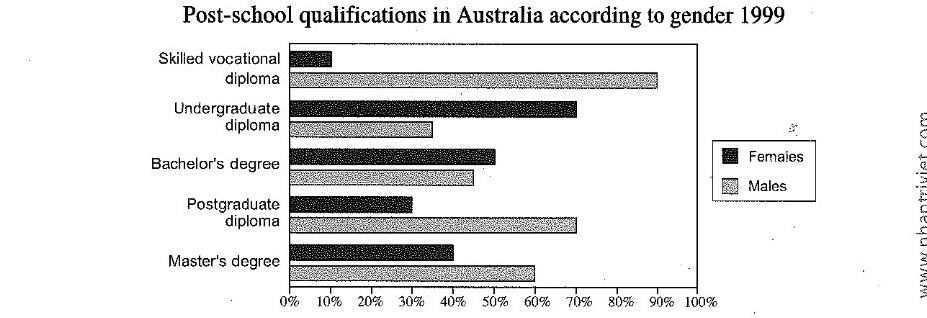
The bar chart below shows the percentage of men and women in Australia who held five types of post-school qualification in 1999. Summarise the information by selecting and reporting the main features, and make comparisons where relevant.
02 · Band 9 sample answer
190 words · Band 9The bar chart compares the percentage of men and women in Australia who held five kinds of post-school qualification in 1999.
Overall, a clear gender divide is evident: men were far more likely to hold vocational and higher postgraduate qualifications, whereas women predominated in undergraduate diplomas. Only bachelor's degrees were shared roughly equally between the sexes.
The most pronounced imbalance was in skilled vocational diplomas, which were held overwhelmingly by men, at around 90% compared with just 10% for women. Men also made up the majority of those with postgraduate diplomas and master's degrees, at roughly 70% and 60% respectively.
Women, on the other hand, dominated one category in particular: undergraduate diplomas, some 70% of which were held by women against only 30% by men. The one qualification approaching parity was the bachelor's degree, split fairly evenly at approximately 50% for women and 45% for men — the closest the two sexes came across all five categories.
03 · Why this scores Band 9
The response covers all five qualifications, opens with an overview capturing the gender divide (men dominant in vocational and higher postgraduate awards, women in undergraduate diplomas), and then reports the figures with comparisons. It highlights the most extreme imbalance and the one near-equal category rather than listing every bar.
The report is logically split — overview, then a paragraph on the male-dominated qualifications and one on the female-dominated and balanced ones. Cohesion is smooth and varied — "The most pronounced imbalance was...", "Men also made up the majority of...", "Women, on the other hand, dominated...", "The one qualification approaching parity...".
Comparison vocabulary is precise and varied — "a clear gender divide", "far more likely to hold", "predominated in", "the most pronounced imbalance", "made up the majority", "approaching parity" — describing proportions and gender differences without repetition.
A range of structures presents the figures accurately: a "whereas" contrast ("whereas women predominated in undergraduate diplomas"), a "respectively" comparison ("roughly 70% and 60% respectively"), and a reduced relative ("some 70% of which were held by women"). Hedging ("around", "roughly", "approximately") is used correctly, and the figures are error-free.
04 · Useful collocations for this task
Tap a phrase to see what it means and how to use it. Natural collocations like these lift your Lexical Resource score.
05 · Frequently asked questions
How do I report a chart comparing two groups across categories?
Group the categories by which side leads — here, the male-dominated qualifications, then the female-dominated and the balanced one. Reporting the pattern (who dominates where) rather than each bar in turn is what earns Task Achievement.
Should I use exact figures?
Use hedged figures — "around 90%", "roughly 70%" — since bar values are read approximately. Pair each with a comparison ("compared with just 10%") so the numbers support a described contrast.
What tense should I use?
The past simple, because the data is for a single past year, 1999 ("men were more likely to hold...", "women dominated..."). Keep it consistent throughout.
How long should a Task 1 answer be?
At least 150 words; a band-9 answer is usually 170–200. This model is 190 words, enough for an overview and the key gender comparisons across all five qualifications. Spend about 20 minutes on Task 1.
Want feedback on your own answer?
Toey grades your essay on Task, Coherence, Lexical Resource and Grammar, then shows exactly how to reach the next band — free to start.
Try the free IELTS Writing grader