
IELTS Academic Writing Task 1: School Site Map Changes (Band 9 Sample)
This Academic Task 1 asks you to compare two maps of a school site — in 2013, with 600 students, and in 2016, with 1,000. A band-9 response gives an overview of the overall expansion, then reports the specific changes using the past passive and language of location and change. Below is a model answer of roughly 185 words, followed by why it scores 9 on all four criteria.
Get your own IELTS essay graded by AI
Band scores on all four criteria, line-by-line corrections and a model rewrite — free to start.
01 · The task
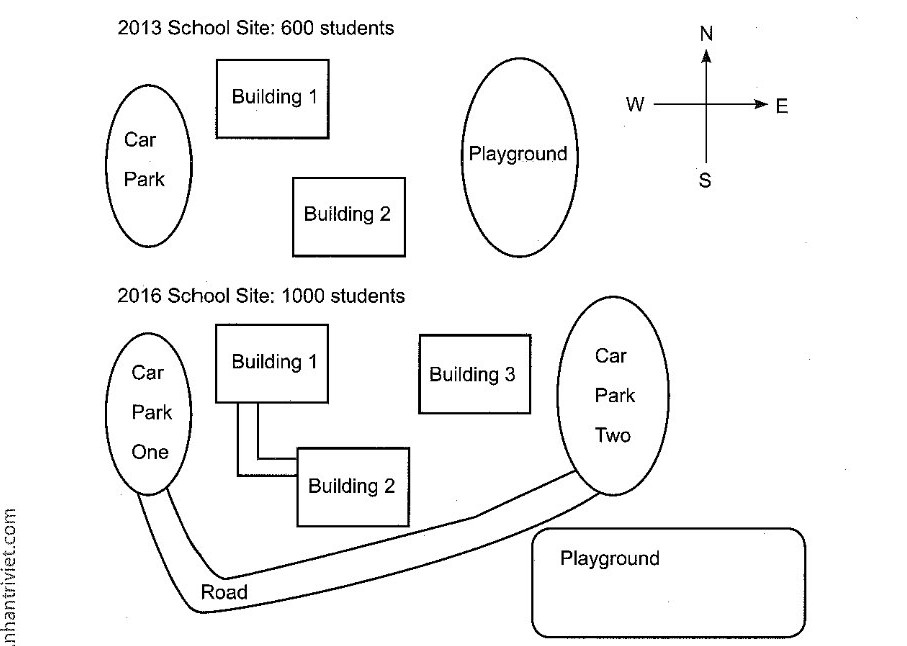
The two maps below show a school site in 2013, when it had 600 students, and in 2016, when the number had grown to 1,000. Summarise the information by selecting and reporting the main features, and make comparisons where relevant.
02 · Band 9 sample answer
184 words · Band 9The two maps compare the layout of a school site in 2013, when it had 600 students, with its layout in 2016, by which time enrolment had risen to 1,000.
Overall, the site was considerably expanded and reorganised to accommodate the larger number of students. The main developments were the addition of a new building and a second car park, along with the relocation of the playground and the construction of a connecting road.
In 2013, the site was relatively simple, consisting of a car park to the west, two buildings in the centre and a large playground to the east. By 2016, this had changed markedly. A third building had been constructed, and the original two buildings had been joined together by a walkway.
The eastern side saw the greatest change. The original playground was removed and replaced by a second car park, Car Park Two, while the old car park was renamed Car Park One. The playground itself was rebuilt, larger than before, in the south-eastern corner. Finally, a new road was added along the southern edge, linking the two car parks.
03 · Why this scores Band 9
The response reports every significant change — the third building, the walkway joining the first two, the new Car Park Two on the old playground site, the relocated and enlarged playground, and the connecting road — and frames them as an expansion driven by the rise in student numbers. It selects the meaningful developments rather than listing every feature.
The changes are grouped logically — the buildings first, then the eastern side and the road — rather than listed at random. Location and change phrases guide the reader throughout — "to the west", "in the centre", "The eastern side saw the greatest change", "in the south-eastern corner", "along the southern edge".
Change and location vocabulary is precise and varied — "was considerably expanded", "the addition of a new building", "joined together by a covered walkway", "removed and replaced by", "was renamed", "rebuilt, larger than before" — avoiding a flat repetition of "changed" or "built".
The past and past-perfect passive are used accurately to describe the changes — "was considerably expanded", "had been constructed", "had been joined together", "was removed and replaced by", "was renamed" — alongside a "by which time" clause ("by which time enrolment had risen to 1,000"). The writing is error-free.
04 · Useful collocations for this task
Tap a phrase to see what it means and how to use it. Natural collocations like these lift your Lexical Resource score.
05 · Frequently asked questions
What tense should I use to describe changes between two maps?
Use the past simple passive for the changes ("a car park was built"), and the past perfect where you look back from the later map ("a third building had been constructed"). The passive keeps the focus on the site, not on who did the work.
How should I organise a map answer?
Group the changes by area — here, the buildings, then the eastern side, then the road — rather than listing them randomly. Moving through the site in a logical order reads far more coherently.
Should I mention the reason for the changes?
A brief link is effective — noting the expansion was to accommodate the rise from 600 to 1,000 students ties the changes together. Keep it short; most of the answer should describe what actually changed.
How long should a Task 1 answer be?
At least 150 words; a band-9 answer is usually 170–200. This model is 184 words, enough for an overview and all the main changes grouped by area. Spend about 20 minutes on Task 1.
Want feedback on your own answer?
Toey grades your essay on Task, Coherence, Lexical Resource and Grammar, then shows exactly how to reach the next band — free to start.
Try the free IELTS Writing grader