This Academic Task 1 asks you to compare two maps of the same harbour — one in 2000 and one today — and to describe how it has changed. A band-9 response gives an overview of the overall transformation, then reports the specific changes using the past passive and language of location and change. Below is a model answer of roughly 190 words, followed by why it scores 9 on all four criteria.
Get your own IELTS essay graded by AI
Band scores on all four criteria, line-by-line corrections and a model rewrite — free to start.
The two maps below show the coastal town of Porth Harbour in the year 2000 and today. Summarise the information by selecting and reporting the main features, and make comparisons where relevant.
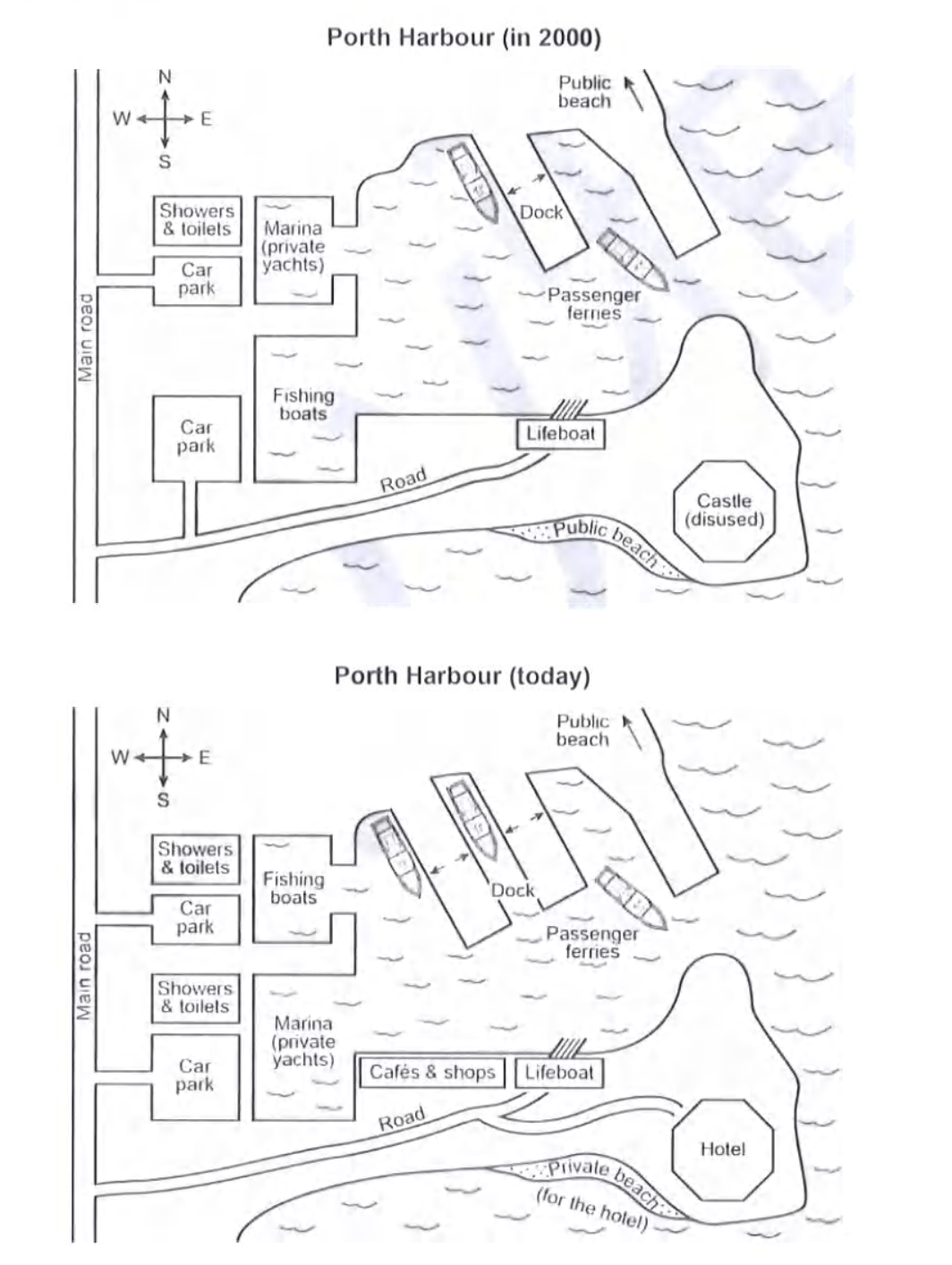
The two maps compare the coastal town of Porth Harbour as it was in 2000 with how it appears today.
Overall, the harbour has been developed for tourism. The most striking change is the conversion of the disused castle into a hotel, while several new visitor facilities have been added and some of the existing amenities have swapped places.
The clearest transformation has occurred on the eastern headland, where the old castle has been turned into a hotel, and the public beach beside it has become a private beach reserved for hotel guests. To the north, cafés and shops have been built next to the lifeboat station, which itself remains unchanged.
Along the western shore, the marina for private yachts and the area for fishing boats have been swapped, so that the fishing boats now occupy the northern berths. In addition, a second block of showers and toilets has been added beside the car parks, and the central dock has been extended to accommodate more vessels.
The response reports every significant change — the castle-to-hotel conversion, the public-to-private beach, the new cafés and shops, the swapped marina and fishing boats, the extra showers and toilets, and the extended dock — and correctly notes what stayed the same (the lifeboat station). The overview captures the overall shift towards tourism.
The changes are grouped logically by area — the eastern headland, then the north, then the western shore — rather than listed at random. Location and linking phrases guide the reader throughout — "on the eastern headland", "To the north", "Along the western shore", "In addition" — giving the report a clear spatial structure.
Change and location vocabulary is precise and varied — "has been converted / turned into", "reserved for hotel guests", "have been swapped", "occupy the northern berths", "has been extended to accommodate more vessels" — avoiding a flat repetition of "changed" or "built".
The present-perfect passive is used accurately to describe change over time — "has been developed", "has been turned into", "have been built", "have been swapped", "has been extended" — alongside a "so that" result clause ("so that the fishing boats now occupy...") and a non-defining relative clause ("the lifeboat station, which itself remains unchanged"). The writing is error-free.
Tap a phrase to see what it means and how to use it. Natural collocations like these lift your Lexical Resource score.
Use the present-perfect passive for changes up to now ("the castle has been converted into a hotel"), or the past passive if both maps are in the past ("was converted"). The passive keeps the focus on the place, not on who did the work.
Group the changes by area or direction — north, south, east, west, or the coastline — rather than listing them randomly. This model moves from the eastern headland to the north to the western shore, which reads far more coherently.
Briefly, yes — noting what stayed the same (here, the lifeboat station) shows full coverage and gives you an accurate comparison, but most of your answer should focus on the changes.
At least 150 words; a band-9 answer is usually 170–200. This model is 190 words, enough for an overview and all the main changes grouped by location. Spend about 20 minutes on Task 1.
Want feedback on your own answer?
Toey grades your essay on Task, Coherence, Lexical Resource and Grammar, then shows exactly how to reach the next band — free to start.
Try the free IELTS Writing grader