
IELTS Academic Writing Task 1: Reasons for Migration Pie Charts (Band 9 Sample)
This Academic Task 1 asks you to describe two pie charts giving people's reasons for leaving, and for staying in, the UK. A band-9 response gives an overview of what the two have in common and where they differ, then reports the key figures with comparisons. Below is a model answer of roughly 190 words, followed by why it scores 9 on all four criteria.
Get your own IELTS essay graded by AI
Band scores on all four criteria, line-by-line corrections and a model rewrite — free to start.
01 · The task
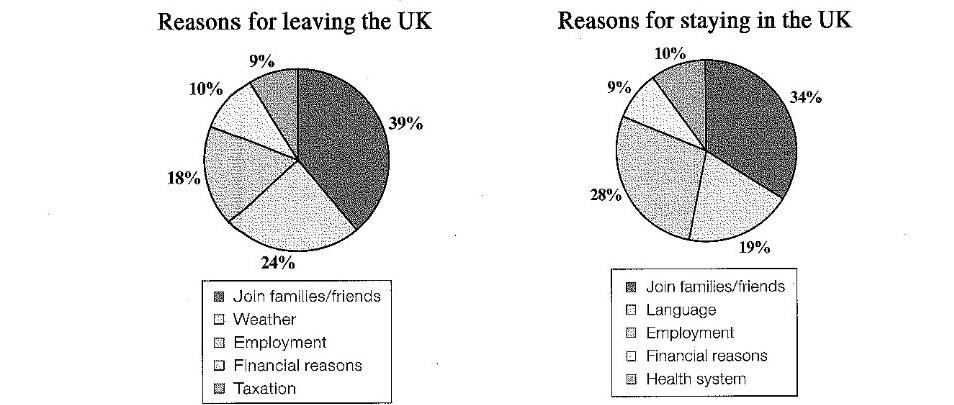
The two pie charts below show the main reasons people gave for leaving the UK and for staying in the UK. Summarise the information by selecting and reporting the main features, and make comparisons where relevant.
02 · Band 9 sample answer
190 words · Band 9The two pie charts set out the main reasons people gave for leaving the UK and, conversely, for choosing to stay there.
Overall, the desire to join family or friends was the leading motive in both cases. Beyond that shared factor, however, the priorities diverged: those leaving were strongly influenced by the weather, whereas employment was the key draw for those who stayed.
Turning first to the reasons for leaving, joining family or friends topped the list at 39%, followed some way behind by the weather at 24% and employment at 18%. Financial reasons and taxation accounted for the remainder, at 10% and 9% respectively.
For those staying in the UK, joining family or friends was again the most cited reason, though slightly lower at 34%. Here, however, employment was far more significant, at 28%, followed by financial reasons at 19%. Language and the health system were the least common motives, at 10% and 9% respectively — the weather, notably, did not feature at all.
03 · Why this scores Band 9
The response covers both charts, opens with an overview capturing the shared top reason and the key divergence (weather for leavers, employment for stayers), and then reports the figures for each with comparisons. It notes the telling detail that the weather appears only among reasons for leaving, rather than listing every slice.
The report is logically split — overview, then one paragraph per chart, signposted "Turning first to the reasons for leaving..." and "For those staying in the UK...". Comparisons are linked naturally: "followed some way behind by...", "again the most cited reason, though slightly lower", "Here, however, employment was far more significant".
Vocabulary is precise and varied — "the leading motive", "the priorities diverged", "the key draw", "topped the list", "some way behind", "the most cited reason", "did not feature at all" — describing reasons and proportions without repetition.
A range of structures presents the figures accurately: a "whereas" contrast ("whereas employment was the key draw for those who stayed"), a "respectively" comparison ("at 10% and 9% respectively"), and a concessive ("again the most cited reason, though slightly lower at 34%"). The percentages are reported without error.
04 · Useful collocations for this task
Tap a phrase to see what it means and how to use it. Natural collocations like these lift your Lexical Resource score.
05 · Frequently asked questions
How do I compare two pie charts?
In the overview, state what they share and how they differ. Here both are topped by "joining family/friends", but the second-place reasons diverge. Then take one paragraph per chart. Comparing, not describing each in isolation, is what earns Task Achievement.
The two charts have some different categories — how do I handle that?
Point it out where it is meaningful. Noting that "the weather did not feature at all" among reasons for staying is a sharp, high-scoring observation, because it captures a genuine difference between the two groups.
What tense should I use?
The past simple, since the survey reports reasons already given ("joining family topped the list", "employment was far more significant"). Keep it consistent throughout.
How long should a Task 1 answer be?
At least 150 words; a band-9 answer is usually 170–200. This model is 190 words, enough for an overview and the key comparisons across both charts. Spend about 20 minutes on Task 1.
Want feedback on your own answer?
Toey grades your essay on Task, Coherence, Lexical Resource and Grammar, then shows exactly how to reach the next band — free to start.
Try the free IELTS Writing grader