
IELTS Academic Writing Task 1: Rain-Shadow Desert Formation (Band 9 Sample)
This Academic Task 1 asks you to describe a diagram showing how rain-shadow deserts form. A band-9 response gives an overview of the whole natural process, then reports the stages in order using the present simple and sequencing language. Below is a model answer of roughly 190 words, followed by why it scores 9 on all four criteria.
Get your own IELTS essay graded by AI
Band scores on all four criteria, line-by-line corrections and a model rewrite — free to start.
01 · The task
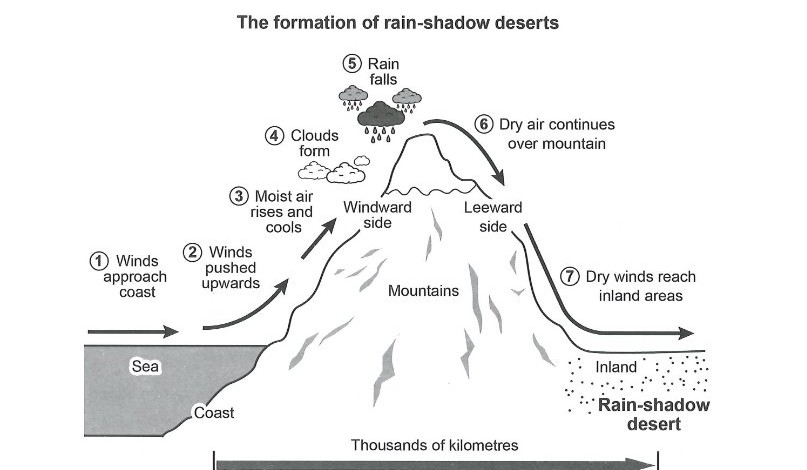
The diagram below shows how rain-shadow deserts are formed. Summarise the information by selecting and reporting the main features, and make comparisons where relevant.
02 · Band 9 sample answer
190 words · Band 9The diagram illustrates the natural process by which rain-shadow deserts are created on the far side of a mountain range.
Overall, the process is linear and consists of seven stages, beginning with moist winds arriving from the sea and ending with the formation of a dry desert far inland. The key mechanism is that the mountains strip the moisture from the air before it can reach the other side.
At the first stage, winds carrying moisture from the sea approach the coast and are then forced upwards by a mountain range. As this moist air rises up the windward side, it gradually cools, which causes clouds to form. Before long, these clouds release their moisture, and rain falls on the windward slopes.
Having lost most of its water, the now-dry air continues over the top of the mountain and descends the leeward side. Consequently, by the time these dry winds reach the inland areas beyond the mountains, they carry almost no moisture, and it is this lack of rainfall that produces a rain-shadow desert.
03 · Why this scores Band 9
The response covers the whole process, opens with an overview that states the number of stages and identifies the key mechanism (the mountains removing moisture), and then reports every stage in order — winds approaching, rising and cooling, clouds and rain on the windward side, dry air descending the leeward side, and the desert forming inland.
The report follows the ideal process shape — introduction, overview, then the stages in sequence. Cause-and-effect and sequencing links are varied and accurate — "As this moist air rises...", "which causes clouds to form", "Before long", "Having lost most of its water", "Consequently" — so the reader follows the mechanism from coast to desert.
Topic vocabulary is precise and natural — "carrying moisture", "forced upwards", "the windward side", "release their moisture", "the leeward side", "lack of rainfall" — using the correct geographical terms rather than repeating "wind" and "rain".
A range of structures is controlled accurately: the present simple and passive for a natural process ("are then forced upwards", "rain falls"), a participle clause ("Having lost most of its water, the now-dry air continues..."), and a cleft for emphasis ("it is this lack of rainfall that produces a rain-shadow desert"). The writing is error-free.
04 · Useful collocations for this task
Tap a phrase to see what it means and how to use it. Natural collocations like these lift your Lexical Resource score.
05 · Frequently asked questions
What tense should I use for a natural process like this?
Use the present simple, with the passive where the cause is a natural force ("the air is forced upwards", "rain falls"). Natural processes are described as general truths, so the present simple is correct throughout.
How do I show cause and effect in a process?
Use links like "as", "which causes", "consequently" and "so that", not just "then". This model traces the mechanism — rising air cools, which forms clouds, which release rain — so the examiner sees you understand the process, not just the labels.
Do I need an overview for a process?
Yes — always. State how many stages there are, whether it is linear or a cycle, and where it begins and ends. Here the overview also names the key mechanism, which lifts Task Achievement.
How long should a Task 1 answer be?
At least 150 words; a band-9 answer is usually 170–200. This model is 190 words, enough to give an overview and describe all seven stages in order. Spend about 20 minutes on Task 1.
Want feedback on your own answer?
Toey grades your essay on Task, Coherence, Lexical Resource and Grammar, then shows exactly how to reach the next band — free to start.
Try the free IELTS Writing grader