
IELTS Academic Writing Task 1: How a Smokehouse Works Diagram (Band 9 Sample)
This Academic Task 1 asks you to describe a diagram showing how a traditional smokehouse is used to preserve food with smoke. A band-9 response opens with an overview of the whole mechanism, then explains the stages in order using the present passive and sequencing language. Below is a model answer of roughly 190 words, followed by why it scores 9 on all four criteria.
Get your own IELTS essay graded by AI
Band scores on all four criteria, line-by-line corrections and a model rewrite — free to start.
01 · The task
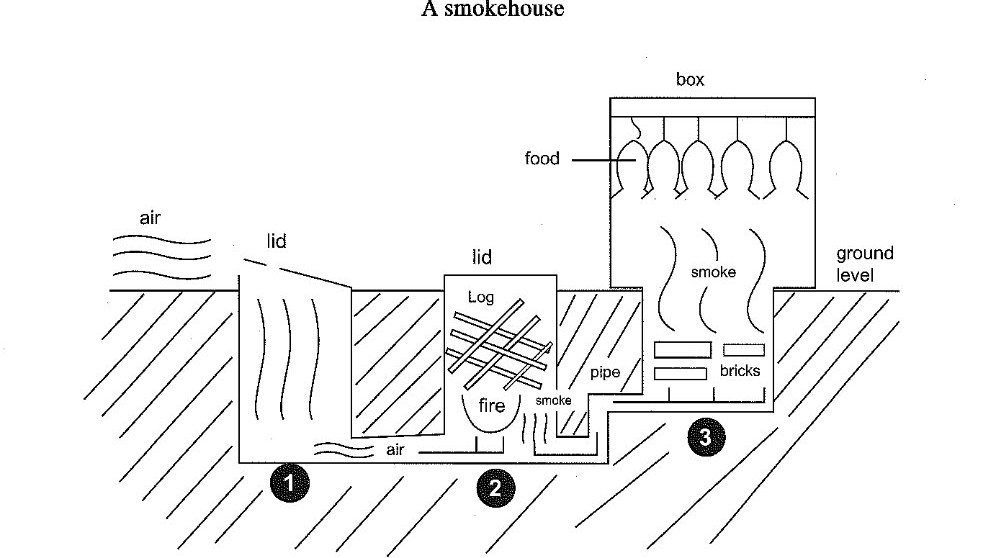
The diagram below shows how a smokehouse is used to preserve food. Summarise the information by selecting and reporting the main features, and make comparisons where relevant.
02 · Band 9 sample answer
190 words · Band 9The diagram illustrates the workings of a traditional smokehouse, a structure used to preserve food by exposing it to smoke.
Overall, the apparatus is made up of three connected chambers and operates by drawing air underground to fuel a fire, then channelling the resulting smoke upwards to a box where the food is cured. The process is continuous, relying on the natural movement of air and smoke.
At the first stage, fresh air enters an open-topped chamber that is set below ground level. This air is then drawn sideways into a second, lidded chamber, where it feeds a log fire. As the wood burns, it generates a steady supply of smoke.
From this middle chamber, the smoke is directed through a pipe and a brick-lined channel, which carry it upwards into a large box situated above ground level. Inside this box, several pieces of food are suspended from the top, and as the smoke rises and passes over them, they are gradually cured and preserved. In this way, the smoke produced underground is put to use at the surface.
03 · Why this scores Band 9
The response covers the whole mechanism, opens with an overview that states the number of chambers and how the device works as a system (air to fire to smoke to food), and then explains each stage in order. It reports how the parts connect and function rather than merely labelling them.
The report follows the ideal process shape — introduction, overview, then the stages in sequence. Sequencing and spatial links are varied and accurate — "At the first stage", "This air is then drawn...", "As the wood burns...", "From this middle chamber...", "In this way..." — so the reader follows the flow from air intake to cured food.
Mechanism vocabulary is precise and varied — "the apparatus", "connected chambers", "feeds a log fire", "generates a steady supply of smoke", "a brick-lined channel", "suspended from the top", "cured and preserved" — using accurate descriptive verbs rather than repeating "goes" and "moves".
The present passive is used correctly throughout — "is set below ground level", "is then drawn sideways", "the smoke is directed through a pipe", "they are gradually cured" — exactly as a how-it-works description requires. An "As..." simultaneous clause ("As the smoke rises and passes over them") and a relative clause ("a pipe... which carry it upwards") add range, and the writing is error-free.
04 · Useful collocations for this task
Tap a phrase to see what it means and how to use it. Natural collocations like these lift your Lexical Resource score.
05 · Frequently asked questions
How is a "how it works" diagram different from a natural process?
The approach is the same — overview then stages in order, using the present passive — but here you describe how a human-made device functions. Focus on how the parts connect and what each does, not just their names.
What tense and voice should I use?
The present simple passive throughout ("air is drawn in", "the smoke is directed through a pipe"), because the focus is on what happens at each stage, not who does it. This is the key grammatical feature of a mechanism description.
Do I need an overview for this kind of diagram?
Yes — always. State how many main parts or stages there are and summarise how the device works as a whole (here, air feeds a fire, and the smoke cures the food). You cannot reach band 7+ without it.
How long should a Task 1 answer be?
At least 150 words; a band-9 answer is usually 170–200. This model is 190 words, enough for an overview and a clear description of all three stages. Spend about 20 minutes on Task 1.
Want feedback on your own answer?
Toey grades your essay on Task, Coherence, Lexical Resource and Grammar, then shows exactly how to reach the next band — free to start.
Try the free IELTS Writing grader